


Sulfate Free Skincare for Teens: A Practical Ingredient Guide
When families search for sulfate free skincare for teens, the first question is often whether sulfates are automatically too harsh for young skin. The answer depends on the formula, the person using it, and how their skin feels after cleansing. A label can offer useful clues, but it does not tell the whole story.
Ask Bright Girl a skincare question
What Does Sulfate-Free Skincare for Teens Mean?
In skincare, “sulfate-free” usually means a product is made without certain sulfate-based cleansing ingredients. These ingredients are surfactants: they help water lift oil, soil, and product residue from the skin. Some can also create the rich lather people associate with a thorough wash.
One familiar example is sodium lauryl sulfate, often shortened to SLS. Sodium laureth sulfate, or SLES, is another ingredient in the same broad family. These are not the only cleansing agents used in face washes, and sulfate-free does not mean “without cleansing ingredients.” A sulfate-free cleanser uses different surfactants or a blend of cleansing ingredients to do the washing.
The words on the front of a package do not establish that a formula is gentle, suitable for every skin type, or more effective. The full formula, how often it is used, the amount, and the skin’s own sensitivity all matter. If a teen’s face feels comfortable after washing and does not remain tight, itchy, or unusually dry, that is useful information. If discomfort persists, the family can pause the product and seek advice from a qualified clinician.
Bright Girl is a dermatologist-created skincare brand for young skin ages 8–24, founded by double board-certified dermatologist Angela Casey, M.D. Its education emphasizes age-appropriate routines and pH-balanced products. For a broader overview of what a simple routine can include, see safe skincare for teens.
Why Do Parents Look for Sulfate-Free Cleansers?
Parents may consider a sulfate-free face wash when a teen reports that cleansing leaves skin feeling stripped or uncomfortable, or when they are trying to simplify a routine for sensitive-feeling skin. A Connecticut Department of Children and Families skin and hair care manual advises sulfate-free, hydrating cleansers for sensitive skin; that is a practical recommendation for that context, not proof that every sulfate-containing cleanser will bother everyone. Read the manual’s skin and hair care guidance.
It also helps to keep expectations realistic. A sulfate-free label is one detail in a product choice, not a guarantee. Some people use a cleanser with a sulfate surfactant without a problem; someone else may find a particular formula uncomfortable. Fragrance, other ingredients, water temperature, cleansing frequency, and the use of additional products can also affect how skin feels.
Skincare conversations have become more visible among adolescents through social platforms, which can make ingredient labels feel high-stakes. An academic review discusses how social media has shifted the way teens engage with beauty and skincare trends. A steady, evidence-aware approach can help families focus on the basics instead of feeling pushed to build a complicated routine. Read the review on teen skincare and social media.
How Can You Read a Cleanser Label?
Start with the ingredient list rather than relying only on a front-label claim. Search for the word “sulfate” in ingredient names, including sodium lauryl sulfate and sodium laureth sulfate. Product formulas vary, and ingredient names can be unfamiliar, so a label should be read as a whole rather than judged by one word alone.
- Check the product type. Confirm that it is a facial cleanser, not a body wash, shampoo, exfoliating product, or leave-on formula. Products made for different areas or purposes may be formulated differently.
- Scan the ingredient list. Look for sulfate names if avoiding these ingredients is a family preference or a clinician’s recommendation. Note that labels can change, so check the current packaging.
- Look for other relevant details. Is the cleanser described as hydrating or intended for sensitive skin? Does the ingredient list include fragrance or other ingredients the user already knows they do not tolerate? “Sulfate-free” alone cannot answer those questions.
- Consider the whole routine. A cleanser is rinsed off, while toners, moisturizers, masks, and sunscreen stay on the skin for different lengths of time. Evaluate each product for its role instead of assuming that one label claim defines the entire routine.
- Ask for professional input when needed. If skin is persistently irritated, painful, or reacting to several products, a parent can ask a dermatologist or other qualified health professional for individualized guidance.
Do not assume that a long ingredient list is automatically unsafe or that a short one is automatically gentle. Ingredient names can describe a functional role, and the finished product depends on the formula as a whole. If the label is unclear, contact the manufacturer or ask a health professional instead of relying on a social post or a broad “clean” claim.
Parents can make the label check more manageable by deciding what matters before shopping. For example, if the teen has a known ingredient sensitivity, check for that specific ingredient first. If the main goal is avoiding sulfate surfactants, focus on that preference and then review the rest of the formula rather than treating every unfamiliar name as a warning. If there is no specific concern and the current wash feels comfortable, there may be no reason to replace it based on a trend. Keeping the package or taking a clear photo of the ingredient panel also makes it easier to compare products later or ask a clinician a focused question.
Does More Foam Mean a Better Clean?
No. Foam is a sensory feature, not a reliable measure of how thoroughly a cleanser works. Some surfactants make abundant lather, while others create little foam. A low-foam wash can still remove everyday dirt, oil, and residue when used as directed. A foamy product is not automatically too harsh, either.
Teens may connect a big lather or a squeaky-clean feeling with success, especially if they have combination or oily skin. But a face that feels tight immediately after washing may be a sign to reconsider the cleanser or the washing habits. Rubbing harder, washing repeatedly, or using very hot water does not make a routine more effective.
A practical cleansing check is simple: use a small amount as directed, move it gently over damp skin, rinse well, and pat dry. Notice how the skin feels shortly afterward and later in the day. The goal is a clean, comfortable feel—not a particular amount of bubbles.
How Do Sulfate-Free and Other Cleansers Compare?
Use this table as a starting point, not as a ranking. The best fit depends on the complete formula and the individual’s experience.
| What you are comparing | Sulfate-free facial cleanser | Cleanser with a sulfate surfactant |
|---|---|---|
| What the label indicates | The formula does not include certain sulfate cleansing ingredients. | The ingredient list includes one or more sulfate surfactants. |
| How it cleans | Uses other surfactants or a blend of cleansing ingredients. | Uses sulfate surfactants, potentially alongside other cleansing ingredients. |
| How much it foams | May produce little, moderate, or noticeable lather, depending on the formula. | May foam noticeably, but lather varies with the complete formula. |
| What to assess | Check the full ingredient list and how skin feels after use. | Check the full ingredient list and how skin feels after use. |
| Who might consider it | Families who prefer to avoid sulfate surfactants or are following advice for sensitive skin. | People whose skin feels comfortable with the particular formula and use pattern. |
Neither column can promise an outcome for every teen. If avoiding sulfates is a priority, choose a current product whose ingredient list meets that preference, then evaluate the whole experience. A guide to pH and skincare can also help explain why pH is one consideration in a cleanser formula, though pH alone does not determine whether a product will suit an individual.
Here is a useful way to compare two options without getting stuck on a single claim:
- Start with the need. Is the family looking for a cleanser that rinses clean, a formula without a specific ingredient, or a product that feels more comfortable? Name the goal before shopping.
- Read the label on the exact product. Product lines can include different formulas. Verify the current ingredient list on the package or official product page rather than assuming every cleanser from one brand shares the same ingredients.
- Check directions and intended use. A facial cleanser should be used as a rinse-off product, not left on like a moisturizer. Follow the label and avoid combining it with extra steps just to compensate for a cleanser that feels uncomfortable.
- Keep a short observation note. For a few days, record which products were used and whether the skin felt comfortable, tight, or itchy afterward. This is not a diagnosis, but it can help a parent and clinician discuss what changed.
- Change one thing at a time. If several products are introduced together, it is difficult to tell which one may be connected to a new sensation. A simple routine makes it easier to observe.
Be cautious of absolute marketing language, including claims that a particular label makes a product universally safe or suitable for all skin. “Free from” statements describe a feature of a formula; they do not replace ingredient review, directions, or personal experience. Parents can also decide how much complexity makes sense for their child’s age and routine. Often, the most useful purchase is the one that addresses a real need and is straightforward to use consistently.
Consider two common shopping situations. A teen who has no known sensitivities and is comfortable with the current wash may simply keep using it as directed, even if it contains a sulfate surfactant. A teen who consistently experiences tightness after washing may try a different formula, including a sulfate-free option, while also reviewing washing frequency and water temperature. In either situation, the label is only one part of the decision. If other products are changed at the same time, it becomes harder to tell which change made a difference.
What Does a Gentle, Age-Appropriate Routine Look Like?
For many tweens and teens, a simple routine is easier to follow and evaluate than a shelf full of new products. A basic approach is to cleanse gently, moisturize as needed, and use sunscreen during daytime. The right steps can vary with age, skin type, preferences, and professional guidance.
- Cleanse: Use a gentle facial cleanser as directed. Avoid scrubbing and repeated washing. A teen can begin with one cleanse at the end of the day, then adjust with guidance if needed.
- Moisturize: Apply a moisturizer if skin feels dry or tight. Hydration can be part of a comfortable routine, including for combination or oily-feeling skin. See more on moisturizers.
- Protect during the day: Choose a broad-spectrum sunscreen and use it according to its directions. Mineral sunscreen is one option; families can review Bright Girl’s sun protection product information as they compare choices.
Introduce only one new product at a time when practical. That makes it easier to notice whether a change coincides with discomfort. Follow package directions and any clinician’s advice. Avoid copying a multi-step routine simply because it is popular online; a routine should suit the person using it and fit comfortably into daily life.
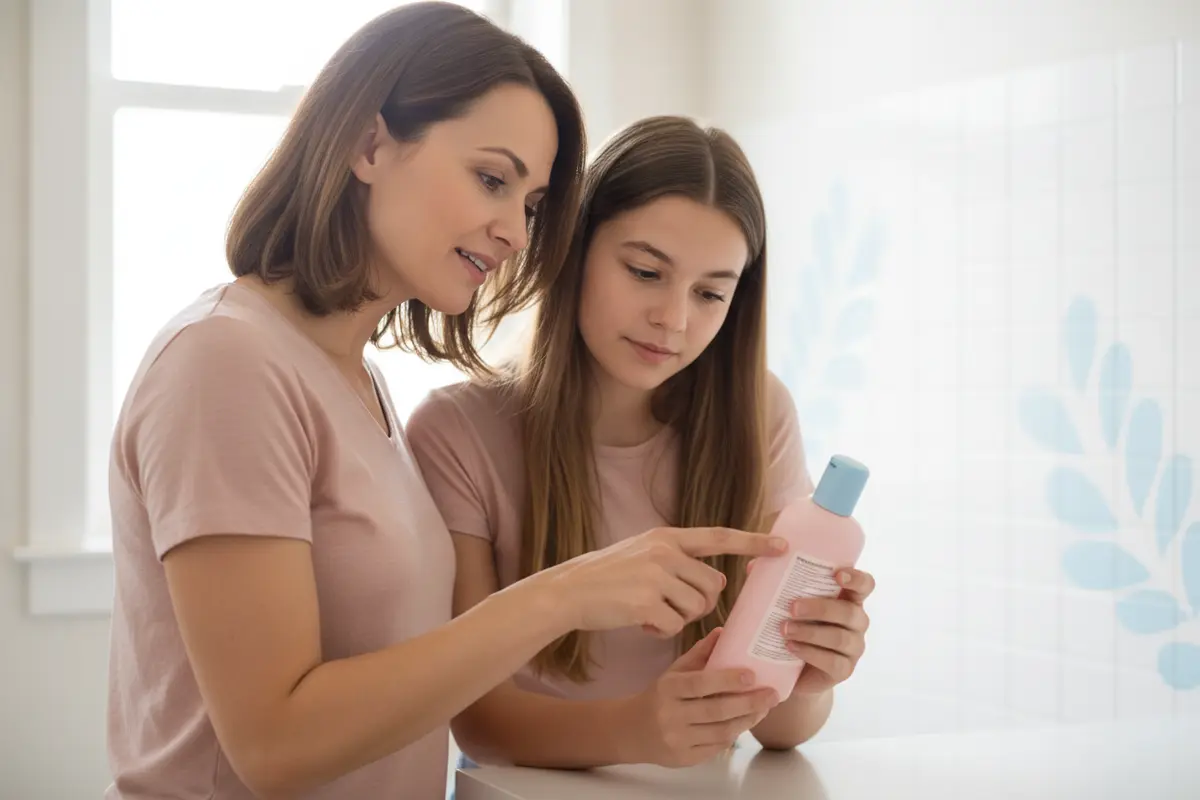
When checking the label together, keep the conversation calm and specific. A parent might ask, “Does your face feel comfortable after washing?” rather than treating a single ingredient as a verdict. This supports a teen’s growing independence while keeping the parent involved in product choices.
A short routine is also easier to repeat on busy mornings and evenings. Parents can make the routine visible without making it complicated: keep the cleanser near the sink, put moisturizer where it will be used, and place sunscreen with the morning essentials. If a teen participates in choosing a product, talk through the purpose of each step and agree on a realistic schedule. The aim is consistent, gentle care—not a perfect routine or a long list of products.
When Should a Family Reconsider a Cleanser?
It is reasonable to pause and reassess a product if the teen consistently notices stinging, itching, tightness, or unusual dryness after using it. Those sensations do not identify a cause on their own. The response may involve the cleanser, how it is used, another routine step, or an unrelated skin concern.
Stop using a product that appears to cause a reaction and seek appropriate medical advice if symptoms are persistent or concerning. A dermatologist can help review the routine and advise on next steps. For ongoing blemishes, painful skin, or concerns that affect confidence, professional guidance is more useful than continually adding stronger products or changing several steps at once.
Parents can bring the product packaging or a clear photo of its ingredient list to an appointment, along with notes about when the product was started and how often it is used. This gives the clinician concrete details to consider. Bright Girl’s Our Story page offers more information about the dermatologist-created brand and its focus on young skin.
Frequently Asked Questions
Are sulfates always bad for teen skin?
No single ingredient label can determine how every person will respond. Some teens may prefer to avoid sulfate surfactants, while others may find a particular cleanser comfortable. Consider the whole formula, directions, and the skin’s response.
Does sulfate-free mean the cleanser is fragrance-free?
No. Sulfate-free refers to the absence of certain sulfate cleansing ingredients. Check the complete ingredient list for fragrance and any other ingredients a teen or parent wants to avoid.
Can a sulfate-free cleanser still foam?
Yes. Foam depends on the full formula and the surfactants it contains. Some sulfate-free cleansers lather, and some produce less foam. Lather alone does not show how gentle or effective a cleanser is.
Should a teen switch products just because a cleanser contains sulfates?
Not necessarily. If the current cleanser is used as directed and skin feels comfortable, a change may not be needed solely because of one ingredient. Families with a concern can review the label or ask a qualified clinician.
How often should a teen wash their face?
Follow the cleanser directions and keep the routine gentle. Many families start with a simple end-of-day cleanse and avoid scrubbing or repeated washing. A dermatologist can give individualized guidance when a teen has persistent concerns or sensitivity.
The best cleanser is not defined by foam or one ingredient claim; it is a formula the teen can use as directed while maintaining a comfortable, age-appropriate routine.
